
What Is KPV? A Plain-English Guide
KPV explained simply: the last three beads of a thirteen-bead hormone, and why that tail end gets studied on its own.
KPV is the shortest peptide we sell. Three beads.
The interesting question is why anyone studies a three-bead scrap at all, when the molecule it came from is thirteen beads long.
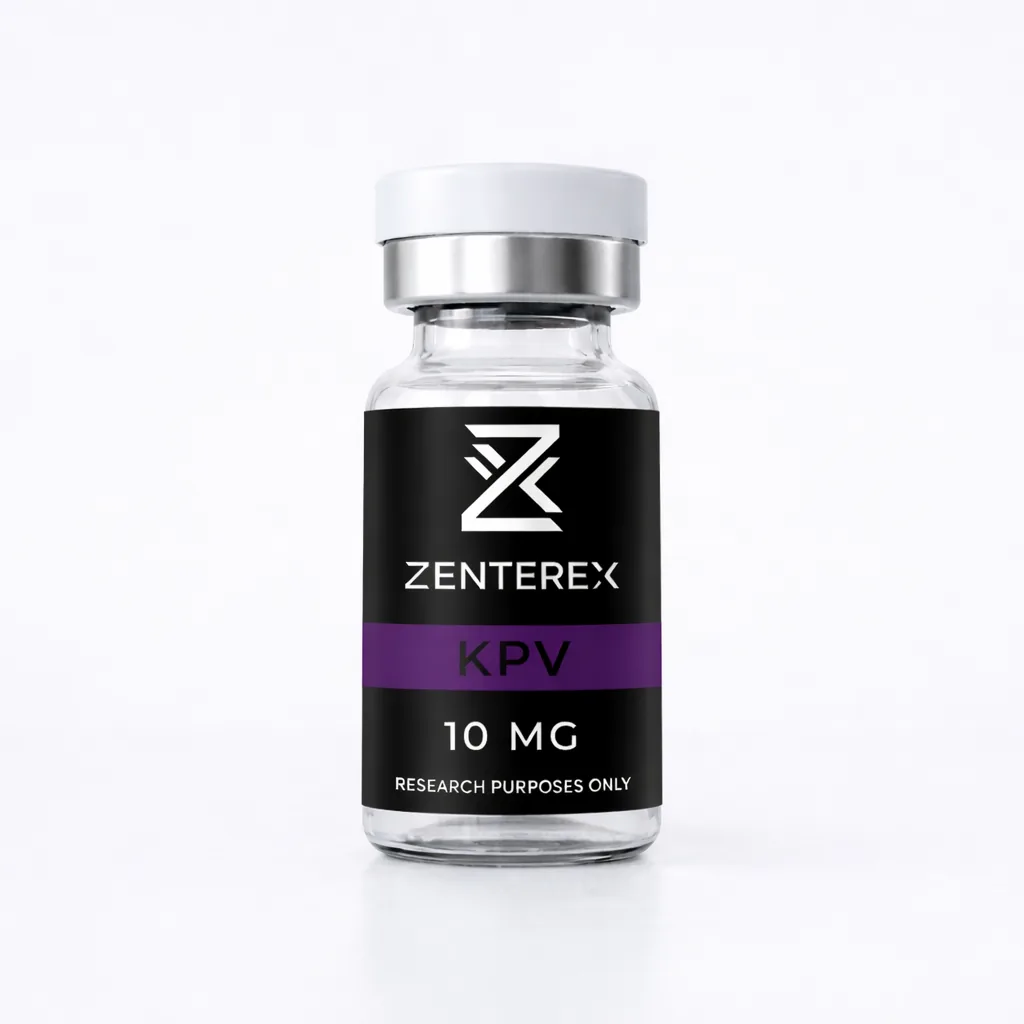
KPV comes as a freeze-dried powder, for lab research only.
What the molecule is
KPV has three beads, and its name is just its sequence in shorthand. Lysine, proline, valine.
It is the tail end of a hormone called alpha-MSH. Alpha-MSH is thirteen beads long, and KPV is beads 11, 12 and 13.
- Molecular weight: 416.47 g/mol
- CAS number: 62007-35-6
- Comes as a freeze-dried powder, in a 10mg vial
- Store it at minus 20 degrees Celsius, away from light
At 416.47 g/mol it sits with GHK-Cu at the small end of our range. The two are worth comparing. Both are three beads. Both come from something bigger. They have nothing else in common.
Why the tail end gets studied on its own
The reason comes down to which part of the parent hormone does what.
Alpha-MSH fits the pigment receptors. But most of that published activity depends on a stretch in the middle of the molecule, not on the tail. The pigment-receptor compounds described in that literature are built around that middle stretch.
KPV does not contain it.
So the published interest in KPV rests on a specific claim. Some of the inflammation-related signalling linked to alpha-MSH in dish work appears to survive in the tail end alone. If so, that would put KPV on a route separate from the pigment receptors entirely.
Think of a key with a long handle. If the handle alone still does something, that something is not happening at the lock.
Whether the separation is as clean as it sometimes gets presented is an open question in published research. It is the thing to keep in mind when reading this field.
What researchers have looked at
Published studies in dishes and in animals cover three areas.
NF-kB signalling
The most reported area. NF-kB is a switch that controls inflammatory genes. Dish tests measure whether it moves into the cell nucleus, or how active the genes it controls become.
Inflammatory signal levels in culture
Following from the above. Published work reports levels of inflammatory signalling molecules in cultured cells that have been given something to react to.
How it gets into cells
A smaller body of work asks how a molecule this small gets inside a cell, with transporters reported to be involved.
That matters practically. It decides whether an effect seen in a dish is happening inside the cell, or at a receptor on the surface.
Practical notes on a very small peptide
Its size has real effects, running in both directions.
**You get a lot of molecules.** A 10mg vial at 416.47 g/mol holds a great many more molecules than a 10mg vial of something heavy. Comparing weights across the range without converting will mislead you. Our calculator converts.
The analysis is easy. Three beads means barely any steps where something can go wrong. So the impurities in a three-bead peptide are far simpler than in a long chain.
**It is hard to see.** KPV has no aromatic beads, so it barely absorbs at the 280 nanometre wavelength sometimes used in chromatography. Analysis is normally run at around 214 nanometres instead, where the peptide bond itself absorbs. That is why the detection wavelength on a report matters, as our note on reading a batch report covers.
Reading the research
The main trap is the parent molecule. A large body of published work is about alpha-MSH, not about KPV. Findings about the full thirteen-bead hormone do not automatically apply to its tail end, and second-hand sources blur the two constantly.
Check which molecule a paper used. That is the same first step TB-500 demands with its own parent protein.
Handling and paperwork
A 10mg vial of freeze-dried powder. Keep it at minus 20 degrees Celsius, out of the light. The product page says what it dissolves in.
Batch analysis is published. Each report confirms identity by weighing the molecule against the expected 416.47 g/mol, and reports purity by chromatography.
KPV sits in our cytoprotective peptides group. It also comes with BPC-157, TB-500 and GHK-Cu as a bundle of separate freeze-dried vials.
Everything we sell is for lab research only. It is not a medicine, and it is not for people or animals to take.