

Copper & Collagen Peptides
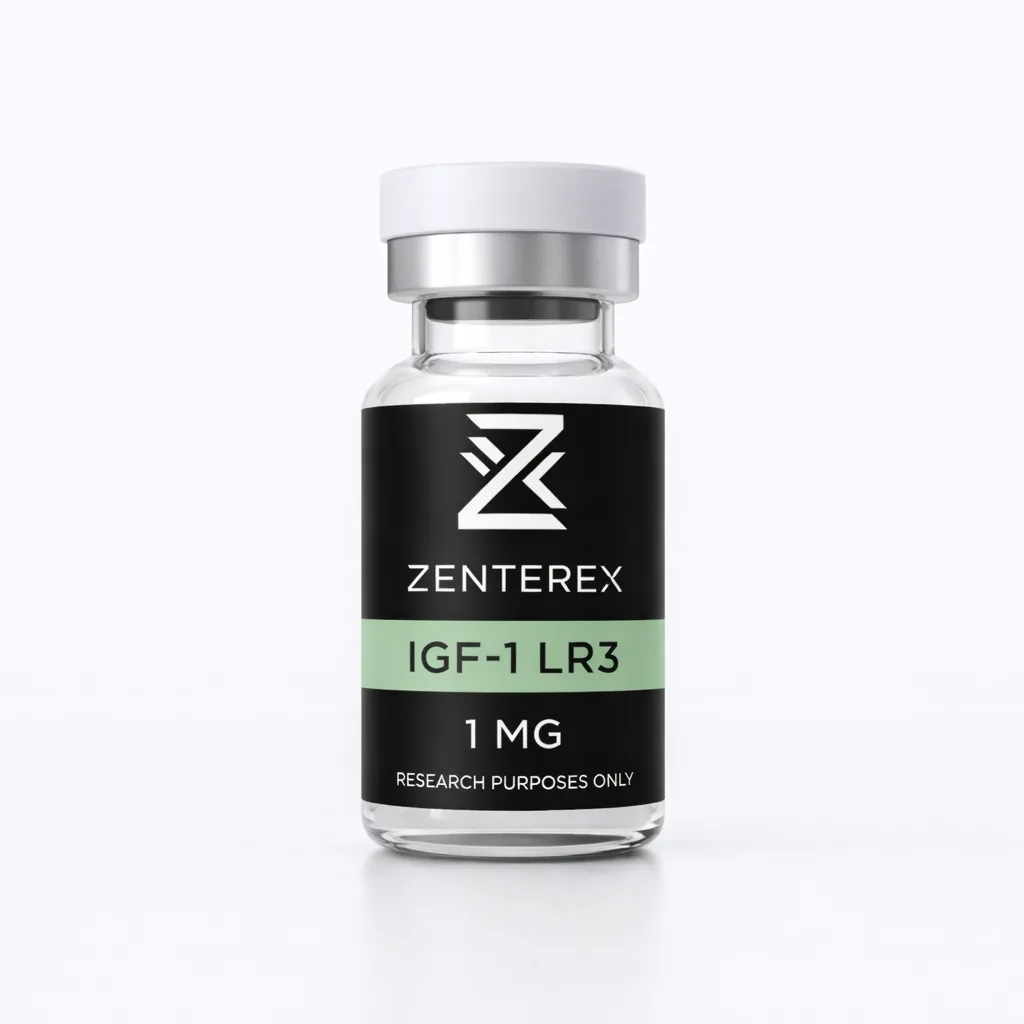
IGF-1 LR3
1mgC₄₀₀H₆₂₅N₁₁₁O₁₁₅S₉ (approximate)
Key Research Findings
- Characterisation of the LR3-modified IGF-1 sequence and reduced IGFBP affinity.
- Published cell-culture studies on PI3K/Akt-pathway activation.
- In-vitro mitogenic assays in multiple cell lines.
Overview
IGF-1 LR3 is a recombinant analogue of IGF-1, modified with an N-terminal extension and an Arg-for-Glu substitution at position 3. Supplied as a lyophilised powder for in-vitro research use only.
Mechanism of Action
Reported in published in-vitro studies as an IGF-1-receptor (IGF1R) ligand active on the PI3K/Akt and MAPK/ERK signalling cascades in cell-culture assays. Not intended for human or veterinary use.
Research Effects
IGF1R Binding
Extensive ResearchCharacterised in receptor-binding assays as a high-affinity ligand of the IGF-1 receptor.
PI3K/Akt Pathway Studies
Extensive ResearchPublished cell-culture studies report activation of the PI3K/Akt signalling cascade.
Mitogenic Cell Assays
Moderate ResearchIn-vitro assays report mitogenic activity in multiple cell lines used as research tools.
Laboratory Research Only — All information on this page is provided for scientific research purposes only. This is a certified reference material sample sold and distributed for laboratory research only.
Quick Facts
Research Status Key
Related Peptides
Copper & Collagen Peptides
GHK-Cu
GHK-Cu is a synthetic copper-tripeptide complex (Glycyl-L-Histidyl-L-Lysine bound to Cu²⁺). Supplied as a lyophilised powder for in-vitro research use only.
Learn More →
Copper & Collagen Peptides
Epitalon
Epitalon (Epithalon) is a synthetic tetrapeptide derived from a sequence identified in pineal-gland extracts. Supplied as a lyophilised powder for in-vitro research use only.
Learn More →
GH Secretagogue Peptides
CJC-1295 (No DAC)
CJC-1295 (No DAC) is a synthetic 29-residue analogue of growth-hormone-releasing hormone (GHRH), without the Drug Affinity Complex linker. Supplied as a lyophilised powder for in-vitro research use only.
Learn More →