

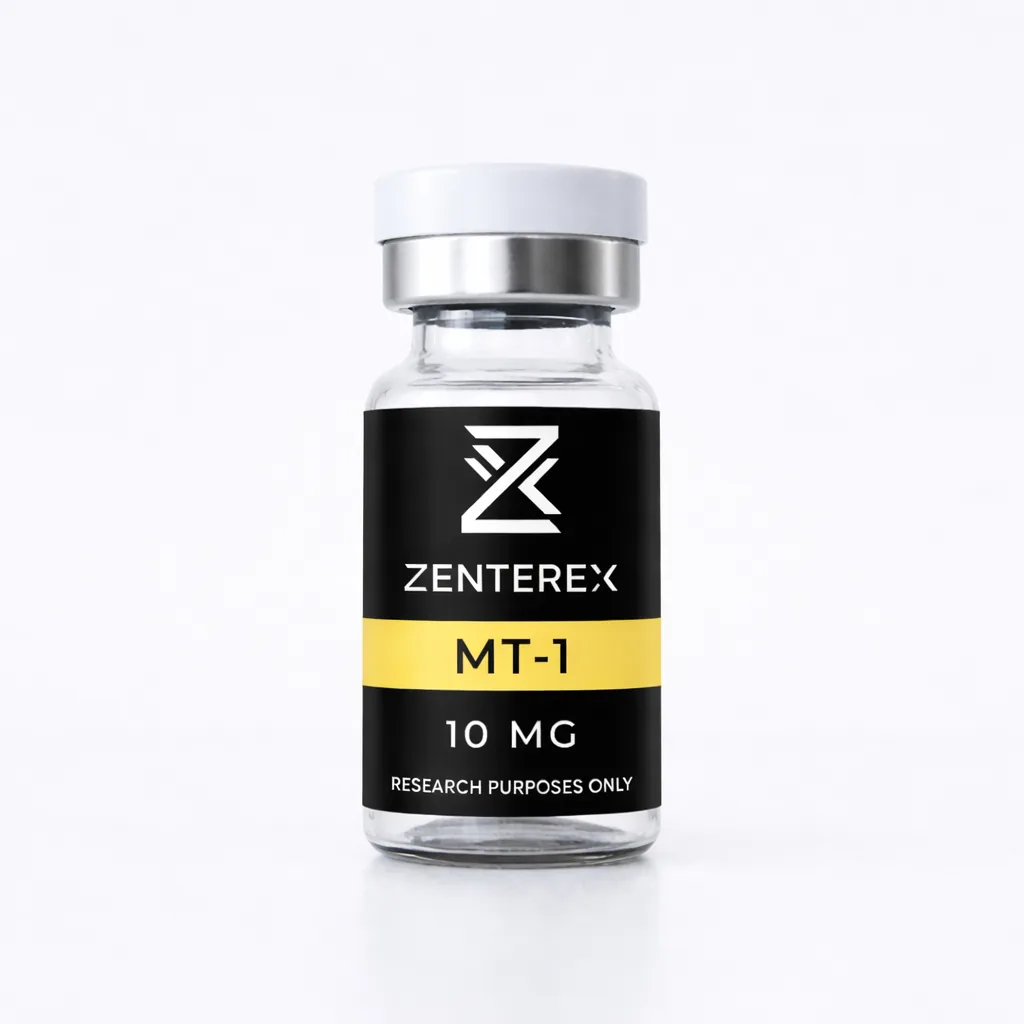
Copper & Collagen Peptides
MT-1
10mgC₇₈H₁₁₁N₂₁O₁₉
Key Research Findings
- Characterisation of the MC1R-selective tridecapeptide sequence.
- Published melanocyte cell-line cAMP assay data.
- In-vitro tyrosinase enzyme-assay studies.
Overview
MT-1 (Melanotan I / Afamelanotide) is a synthetic 13-residue analogue of α-MSH. Supplied as a lyophilised powder for in-vitro research use only.
Mechanism of Action
Reported in published in-vitro studies as a selective MC1R-receptor ligand active on melanocyte cell-line cAMP assays. Not intended for human or veterinary use.
Research Effects
MC1R Receptor Binding
Extensive ResearchReported in receptor-binding assays as a selective high-affinity ligand of the MC1R melanocortin receptor.
cAMP Cell Assays
Extensive ResearchPublished melanocyte cell-line studies report effects on adenylyl-cyclase / cAMP pathway activity.
Tyrosinase Enzyme Studies
Moderate ResearchIn-vitro studies report effects on tyrosinase enzyme expression in cell culture.
Laboratory Research Only — All information on this page is provided for scientific research purposes only. This is a certified reference material sample sold and distributed for laboratory research only.
Quick Facts
Research Status Key
Related Peptides
Copper & Collagen Peptides
MT-2
MT-2 (Melanotan II) is a synthetic cyclic heptapeptide non-selective melanocortin-receptor agonist. Supplied as a lyophilised powder for in-vitro research use only.
Learn More →
Copper & Collagen Peptides
Epitalon
Epitalon (Epithalon) is a synthetic tetrapeptide derived from a sequence identified in pineal-gland extracts. Supplied as a lyophilised powder for in-vitro research use only.
Learn More →