
Peptide Storage: Temperature, Light and Time
A practical storage reference for research peptides: temperature tiers, containers, freezer organisation, what to do on arrival, and the records that make it traceable.
Storage is the one part of a compound's life we do not control. You entirely do. A batch report describes the material as it left the lab. What happens afterwards decides how much of that description still holds when you open the vial.
This is the practical reference. Our notes on freeze-drying and how long freeze-dried peptides last cover the chemistry.
The three variables
Everything reduces to temperature, light and time, and the three interact.
Temperature sets the rate of every chemical process involved. Lower is slower.
Light carries energy that certain structures soak up. Aromatic beads, sulphur beads, and metal complexes above all.
Time is the multiplier. Breakdown adds up. What matters is not whether it was ever warm or ever lit. It is the total across its whole life.
That last point is the one most often missed. Ten brief excursions add up in the same way one long one does.
Temperature tiers
Different states of the same compound belong at different temperatures.
Minus 20 degrees Celsius, freeze-dried. The published condition for essentially our whole range. The default for long-term holding of dry material. A standard lab freezer is enough.
Minus 80 degrees Celsius. Used for very long-term holding and for some reconstituted stocks. Slower breakdown, at the cost of access and equipment. For freeze-dried material within its published window it is generally unnecessary.
2 to 8 degrees Celsius. A refrigerator. Appropriate for short working periods and for material in active use over days rather than months. Not a substitute for freezer storage.
**Room temperature.** Fine for freeze-dried powder in the post, as our note on cold chain logistics covers. Fine too for the short spell while you handle it. Not a storage condition.
The key division is not between numbers on a dial but between dry and dissolved. Freeze-dried material under published conditions holds for months to years. The same compound in solution is published in days to weeks. No storage temperature closes that gap.
Containers and light
Amber glass absorbs ultraviolet and short-wavelength visible light while remaining transparent enough to inspect. The standard for light-sensitive material.
Opaque secondary packaging is at least as effective and usually easier. A vial in a closed box in a freezer receives essentially no light whatever the glass.
Foil is the practical answer for clear-glass vials and costs nothing.
Freezers with internal lighting expose their contents every time the door opens. Storing vials inside an opaque box removes the question completely. That is why it is worth doing as a default rather than per compound.
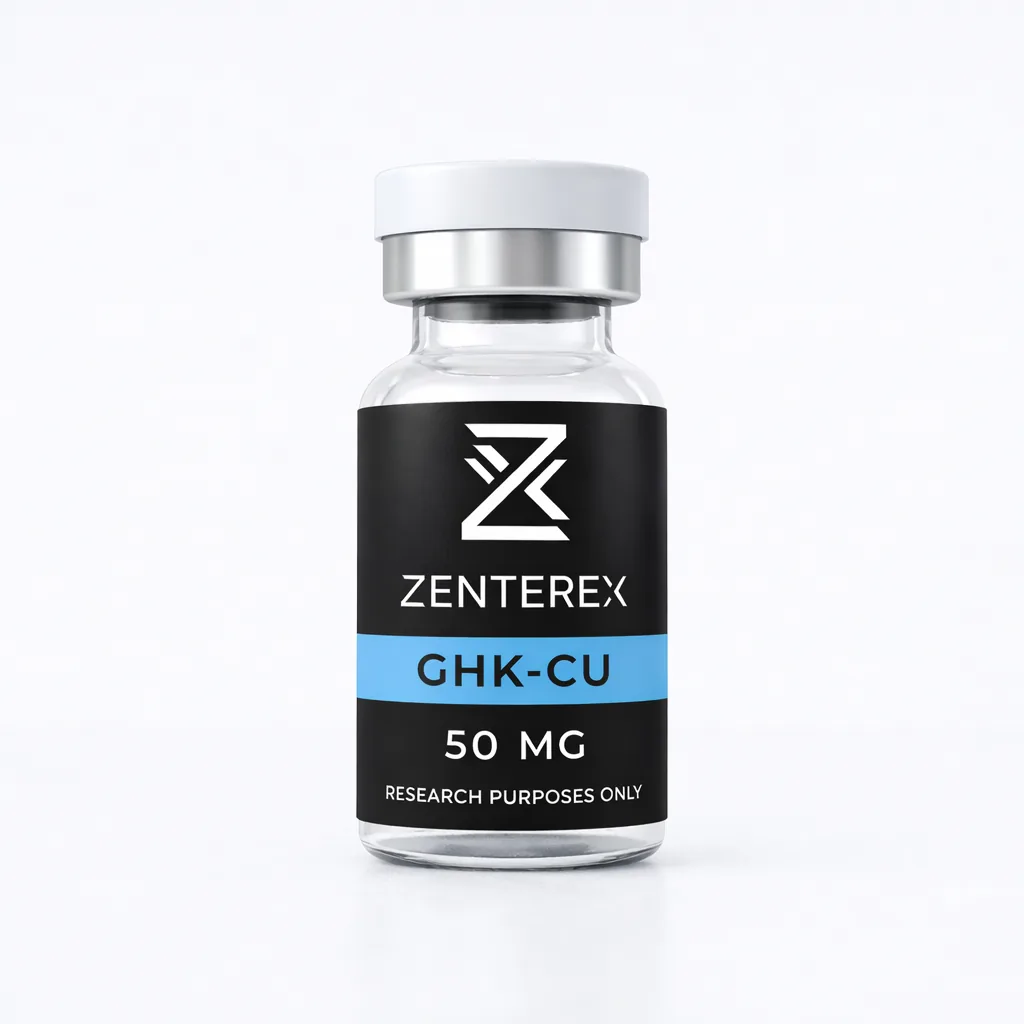
Light matters most for GHK-Cu, which is blue precisely because it soaks up visible light. It matters for Methylene Blue too, a dye and published photosensitiser. It matters least for small peptides with no aromatic residues. We use the same condition across the whole range. One rule is easier to follow correctly than a different rule per compound. Applying it unnecessarily costs nothing.
On arrival
Five steps, in order.
- 1.Check the batch number on each vial against the delivery, and against the corresponding report.
- 2.Move vials to storage promptly. A parcel left at a reception desk over a weekend spent it warm, however it travelled.
- 3.Record the arrival date with the batch number.
- 4.Do not open vials to inspect them. Appearance is not a quality signal. Opening a vial to look at it costs more than the reassurance is worth.
- 5.Store dry. Reconstitute only what near-term work requires.
Freezer organisation
Unglamorous and disproportionately valuable.
Store in a labelled box, not loose. Loose vials get lost behind other material. Searching for one means holding the freezer door open.
Group by compound, so that finding one does not mean handling several.
Keep a location record. A simple index of what is where turns a five-minute search into a ten-second retrieval. Every minute of searching is a minute of door-open warming for everything in the freezer.
Minimise door-open time. The cumulative effect on a whole freezer's contents is larger than on any single vial.
Avoid the door shelves. They experience the largest temperature swings.
Handling that costs stability
Two habits do more damage than a few degrees of storage temperature.
Opening a cold vial. Open a vial straight from the freezer and it pulls in damp room air. That water then condenses onto powder that was dried on purpose. Letting it warm up first costs a few minutes. It avoids putting back the one thing most likely to ruin it. This applies to frozen aliquots as much as to original vials.
**Freezing and thawing a solution over and over.** The damage happens at the changeovers, not in the freezer. It comes from freeze concentration, from ice-water surfaces, and from clumping. The losses add up. Splitting a stock into portions is the standard answer, so each portion sees exactly one cycle.
Reconstituted material
Once dissolved, the picture changes and the timescale shortens.
- Aliquot immediately into single-use portions rather than returning to one stock repeatedly.
- Label each aliquot with compound, strength, solvent, batch number and date. An unlabelled tube in a freezer is not a reagent.
- Use low-binding tubes for weak solutions. Peptides stick to plastic, and at low strengths that costs a real share.
- Protect from light, which matters more in solution than in a dry cake.
- Count time in solution as its own variable, independent of cycle count.
The records that make it traceable
Storage practice is only useful if it can be reconstructed later. Worth recording:
- Batch number and arrival date
- Storage location and temperature
- Reconstitution date, solvent and strength
- Aliquot count and freeze-thaw count
- Which batch produced which result
The batch number is the load-bearing item. It ties a result back to the published analysis for the exact material behind it. Without it, something odd noticed months later cannot be checked against anything. It is also what makes batch-to-batch variation visible rather than mysterious.
The division of responsibility
Our side is manufacture, independent per-batch testing, published reports and prompt dispatch. Those establish what the material was when it left.
Storage is the other half. It determines how much of that description holds at the point of use. The storage condition on every product page belongs to the same specification as the purity figure. It is not a footnote to it.
Everything we sell is for lab research only. It is not a medicine, and it is not for people or animals to take.