
What Is FOXO4-DRI? A Plain-English Guide
FOXO4-DRI explained simply: a mirror-image peptide built to get between two proteins, and why that is a much harder target than a receptor.
FOXO4-DRI is unusual in our range on two counts.
It is built entirely from mirror-image beads, in reverse order. And it is aimed at two proteins meeting, rather than at a receptor or an enzyme.
Both are deliberate design choices, and both are worth understanding.
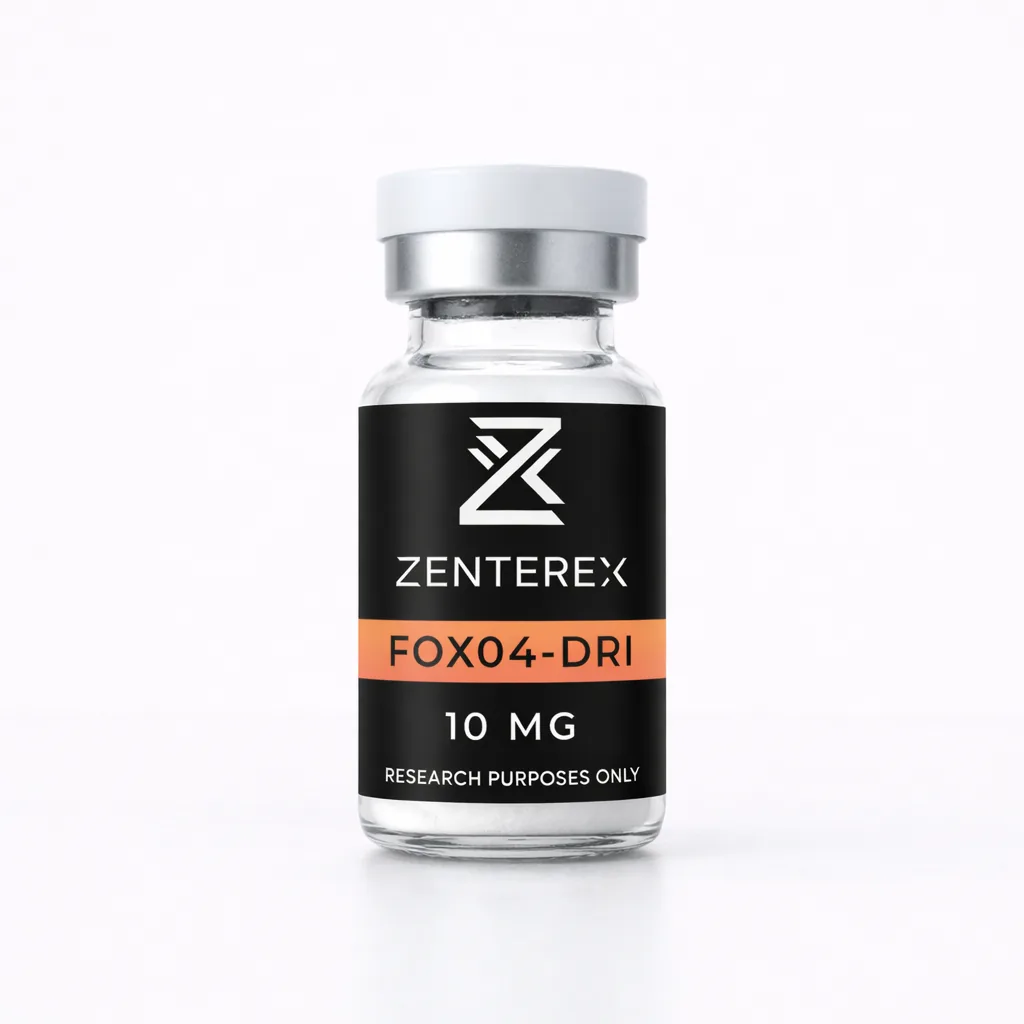
FOXO4-DRI comes as a freeze-dried powder, for lab research only.
What the molecule is
A lab-made D-retro-inverso peptide, built to get in the way of two proteins meeting: FOXO4 and p53.
- Molecular weight: 2246.51 g/mol
- CAS number: 2088986-26-7
- Comes as a freeze-dried powder, in a 10mg vial
- Store it at minus 20 degrees Celsius, away from light
Its long CAS number means it was described recently, around the same time as MOTS-C and Cagrilintide.
The mirror-image design
The DRI on the end means two changes, applied together.
Retro: the order is reversed. Inverso: every bead is swapped for its mirror image.
Do both and the two changes largely cancel out. Think of writing a word backwards and holding it up to a mirror. It reads the right way round again.
So the side branches end up roughly where they were. The backbone underneath runs the other way and is built wrong-handed. A protein partner recognises the pattern of side branches in space, so the molecule can show much the same face while being, chemically, quite different.
The payoff is that enzymes cannot cut it. The enzymes that chop peptides up evolved to cut between ordinary beads. A chain of mirror-image beads is a poor target the whole way along. For a short peptide that is a large win, because getting chewed up fast is the standard problem.
The match is close, not exact. The backbone makes its hydrogen bonds differently, so a DRI copy does not automatically behave like its parent. Our note on D-retro-inverso peptides covers the design in full.
The target: two proteins meeting
This is the more unusual half, and it is worth explaining, because it is a genuinely hard thing to aim at.
Most compounds in the range either fit a **receptor** or block an **enzyme**, like 5-Amino-1MQ at NNMT.
Both of those have a pocket: a cavity shaped to take one particular molecule. That gives a designer something to aim at.
Two proteins meeting has no pocket. They touch across a wide, flat surface. The grip is spread over many tiny contacts rather than concentrated in one cleft.
Think of trying to jam something into a keyhole against trying to stop two hands shaking. There is nowhere obvious to put a small molecule.
That is why targets of this kind were long thought nearly impossible. Peptides are one of the things that changed that. A peptide can offer a wide surface of its own, closer in size to the handshake it is meant to interrupt.
What FOXO4 and p53 are
Brief context.
FOXO4 is a transcription factor. That means a protein that grabs DNA and controls which genes get switched on.
p53 is another transcription factor, and one of the most studied proteins in all of molecular biology. It has a long published record in how cells respond to stress and DNA damage.
The two are reported to interact. Published research links that interaction to cellular senescence. That is the state where a cell stops dividing for good but stays alive and active. FOXO4-DRI is designed to get between them.
What researchers have looked at
Published studies in dishes and in animals cover three areas.
The FOXO4-p53 handshake itself
The designed target. Tests measure how much the two proteins associate, and what the peptide does to that.
Markers of cell ageing
Published work reports measurements of senescence markers in culture, either as gene activity levels or as established staining methods.
Where things sit inside the cell
Both target proteins work inside the nucleus. So published work looks at where things end up in the cell, and how the peptide changes that.
Reading the research
Three cautions.
The field is young and narrow. Compounds aimed at cell ageing are an active area, but a recent one. The work on this peptide comes from a small number of groups. So there is less independent repetition than a citation count suggests.
Senescence in a dish is a model. Researchers bring it on with defined stressors and identify it with defined markers. It is a lab model of a biological state, and findings describe the model.
**The naming varies.** You will see FOXO4-DRI, FOXO4 D-Retro-Inverso, and sequence-based names. Our own range files it under fox04-dri, with a zero rather than the letter O. Worth knowing when you search. The CAS number is the reliable identifier, as our note on why CAS numbers matter explains.
One analytical catch
Specific to mirror-image peptides, and worth flagging.
A bead and its mirror image weigh **exactly the same**. So a DRI peptide and its ordinary counterpart have the same formula and the same expected weight. Weighing the molecule cannot tell them apart.
So confidence rests instead on how the batch was made, and on how it behaves in chromatography. Handedness changes how a molecule grips a column, even though it does not change the weight.
It is the same difficulty that makes an accidentally flipped bead one of the hardest impurities to spot.
Handling and paperwork
A 10mg vial of freeze-dried powder. Keep it at minus 20 degrees Celsius, out of the light. The product page says what it dissolves in.
Batch analysis is published. The report confirms identity by weighing the molecule against the expected 2246.51 g/mol, and reports purity by chromatography.
FOXO4-DRI sits in our peptide analogues group with Epitalon, which reaches cell-ageing research by a completely different route.
Everything we sell is for lab research only. It is not a medicine, and it is not for people or animals to take.