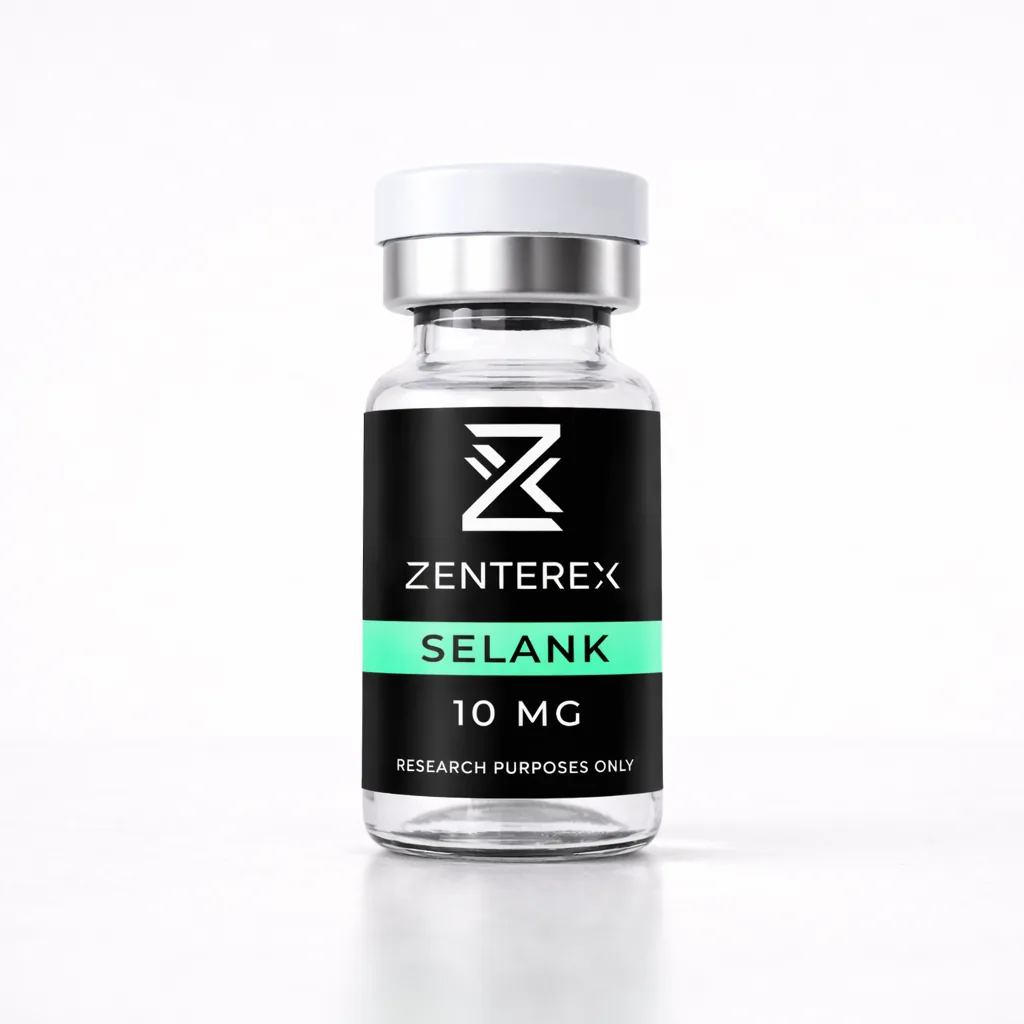


Semax and Selank: A Shared Design, Two Different Molecules
Two seven-bead peptides from the same programme, carrying the same protective cap, built on completely unrelated parents. What they share and what they do not.
Semax and Selank are the most commonly paired compounds in our CNS group. Unlike some pairings in this field, that has a real basis. They came out of the same research programme and share a genuine structural feature.
What they do not share is a parent molecule. That is where the comparison gets interesting.
Side by side
| Semax | Selank | |
|---|---|---|
| Beads | 7 | 7 |
| Molecular weight | 813.93 g/mol | 751.88 g/mol |
| Built on | a piece of ACTH, a pituitary hormone | tuftsin, an immune peptide |
| Protective cap | Pro-Gly-Pro | Pro-Gly-Pro |
| Research is about | BDNF and nerve growth factors | GABA signalling |
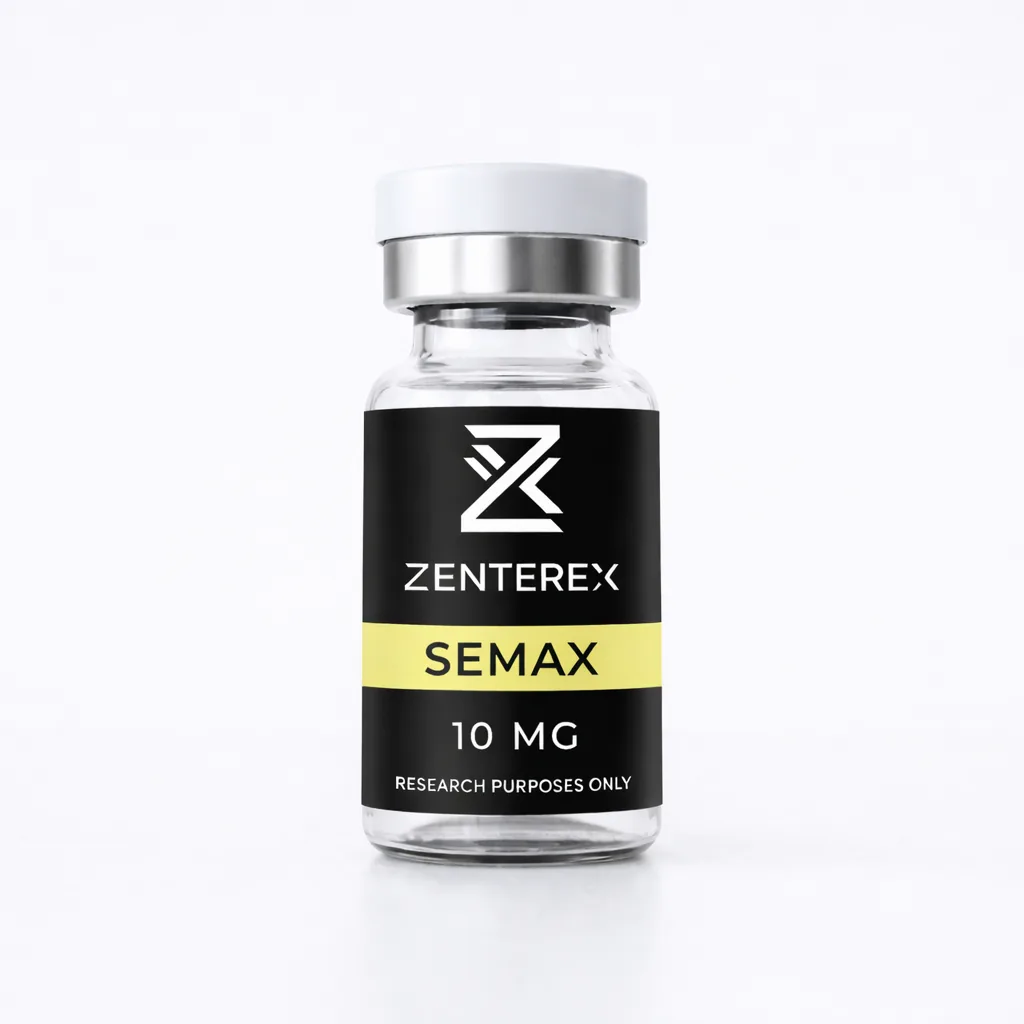
| Vial | 10mg | 10mg |
What they really share
Three things, and all three are real.
Where they came from. Both emerged from the same Russian research programme. That is why they get discussed together, and why their research bodies have the same character.
Length. Both are seven beads. The weights are close enough that the two are easy to muddle on a shelf.
A protective cap. Both carry a Pro-Gly-Pro tail bolted onto the parent piece.
That third one is the substantive point. Proline's side branch loops back and joins the backbone, making a ring. That ring stiffens the chain, and a stiff bit of chain is a poor target for the enzymes that chew peptides up.
So the cap slows the chewing considerably, compared with the bare parent. It is one piece of deliberate design, applied twice. And it is why two compounds of similar length look alike at a glance.
What they do not share
The parents. Which is to say, nearly everything that matters.
Semax is built on a piece of ACTH, a 39-bead pituitary hormone. Beads 4 to 10 of it.
Selank is built on tuftsin, a natural four-bead peptide that comes from an antibody. Its published role is in immune signalling, specifically how scavenging cells behave. It is not a brain peptide at all.
A pituitary hormone fragment and an antibody fragment. No structural relationship. No shared receptor. Their similar length and shared cap are one design habit applied to two unrelated starting points.
The lesson goes well beyond these two. A shared modification is not a shared mechanism, any more than two buildings on the same kind of foundation serve the same purpose.
What each is studied for
The research splits the way the parents do.
Semax is reported in connection with BDNF, a growth factor for nerve cells, and its receptor. Also with the dopamine and serotonin systems, in animal work. Whether it still meaningfully fits the pigment receptors, given its ACTH parent, is itself an open question.
Selank is reported in connection with GABA signalling and the genes tied to it. There is a smaller body of immune work too, reflecting its tuftsin parent.
Reading either research body
The two share a set of problems, which is another consequence of the shared origin.
Much of the original work is in Russian, and predates or sits outside English-language indexing. Tracing a claim to its source is harder here than for most of our range, and English summaries vary a lot in how faithful they are.
Parent confusion is common. Work on ACTH fragments is not work on Semax. Work on tuftsin is not work on Selank. The Pro-Gly-Pro cap is not a trivial change. And fragment numbering like ACTH(4-10) against ACTH(4-7) means genuinely different molecules.
Rodent behaviour is rodent behaviour. A large part of both bodies is behavioural work in rodents. This is where second-hand sources overstate the most.
At the bench
They dissolve differently. Despite the similar size, the published figures differ. The product pages carry them, and one is not a guide to the other.
Analysis is similar. Seven beads means few steps where something can go wrong, so both have simpler impurities than a long chain. Both have published batch reports, each confirming identity against the expected weight.
They are easy to mix up. Similar names, similar length, same vial size, next to each other in the range. Label your portions with the full compound name and batch number rather than an abbreviation. It is worth the extra second.
Why they are grouped together
They turn up together in published research and in experiment designs. So Semax and Selank come as a bundle of two separate freeze-dried vials.
That grouping reflects how they are studied. It says nothing about mixing them.
Both sit in our CNS research peptides group with DSIP. DSIP shares neither their origin nor their design, and its research is far less settled.
Everything in our catalogue is for lab research only. It is not a medicine, and it is not for people or animals to take.