
What Is TB-500? A Plain-English Guide
TB-500 explained simply: the protein it copies, how it relates to the scaffolding cells use to move and repair, and why it is not a version of BPC-157.
TB-500 is studied in connection with tissue repair and cell movement. The way it works is really unlike anything else we sell. It is also the compound most often mistaken for a version of BPC-157, which it is not.
First: what is a peptide?
A peptide is a short chain of amino acids. Amino acids are the building blocks your body uses to make proteins.
Think of beads on a string. A few beads is a peptide. Hundreds is a protein.
TB-500 is a fair-sized one. It weighs 4,963, about three and a half times BPC-157.
What it copies
TB-500 is a lab-made copy of part of a protein called thymosin beta-4. That gets shortened to Tβ4.
Tβ4 is not a hormone and not a signal. It sits inside cells, all over the body. In many cells it is one of the most common proteins there is.
It was first found in the thymus, a gland in the chest. That is where the name came from. But once people looked, it turned up more or less everywhere.
TB-500 copies the part of that protein that does its main job.
The scaffolding job
This is the part worth understanding. It explains everything else.
Cells have an internal skeleton. It is nothing like a bone. It is constantly being built and taken apart again. That is how a cell changes shape, crawls along a surface, or closes a gap.
The main building material is a protein called actin. Actin comes in two states:
- Loose single units, floating free
- Long assembled fibres, forming the scaffolding
A cell moves by building fibres at the front and taking them apart at the back. Think of laying track in front of a train and lifting it up behind. To do that, the cell needs a supply of loose units ready to go, and somewhere to keep them.
That is Tβ4's job. It grabs loose actin units and holds them in reserve. That keeps a pool ready and controls how much scaffolding gets built.
So when research mentions TB-500 and cell movement, this is the machinery involved. Not a receptor. Not a signal. The physical scaffolding cells use to move.
What researchers have looked at
Published work is in cells in dishes and in animals, not people.
Actin and the cell's scaffolding
The most reported area, and the one that follows straight from the parent protein. Studies measure how actin is split between loose units and built fibres. Others watch how the scaffolding is arranged inside cultured cells.
Cell movement in culture
Scaffolding is how cells move, so a lot of the work measures movement directly. The standard method is a scratch wound assay, which is just a lab test with a name that sounds worse than it is. You grow a sheet of cells in a dish. You scrape a clear line through it. Then you film how fast the cells move in to close the gap.
The name causes confusion, so plainly: that is a scratch in a dish of cells. It is a lab technique for measuring how fast cells move. The word "wound" describes the scratch on the plate.
Blood vessel measurements in animals
Published animal work reports measurements to do with blood vessel development. This is described as earlier and less settled than the actin work.
It is not a version of BPC-157
This is the most common misunderstanding, so let us be direct.
The two are often bought together, talked about together, and assumed to be related. They are not related at all:
- Different origins. BPC-157 comes from a sequence found in stomach fluid. TB-500 copies a protein found inside cells.
- Different sizes. TB-500 is about three and a half times heavier.
- Different machinery. BPC-157 research is about chemical signals for blood vessel growth. TB-500 research is about physical scaffolding.
They turn up together because researchers studying tissue repair often want both. That is exactly **because** they work differently, which makes comparing them useful. Our full comparison sets it out.
Reading the research carefully
One caution is specific to this compound. Papers talk about thymosin beta-4, about Tβ4 fragments, and about TB-500. These are not always the same thing. A study on the full protein is not automatically a study on the lab-made fragment. Checking which one was used is a necessary step.
What you get in the vial
If you order TB-500 from us:
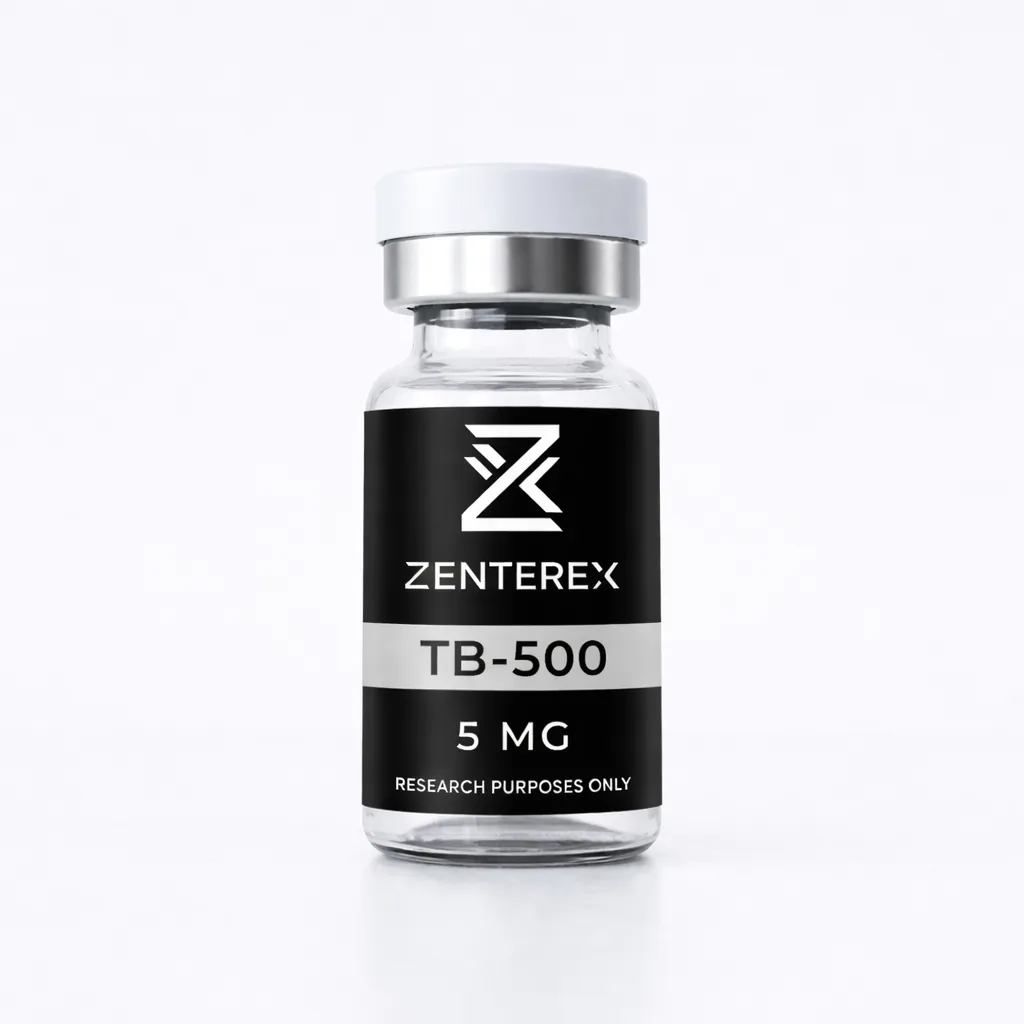
- A glass vial holding 5mg of dry white powder
- Freeze-dried, so it survives the post and stores well
- Keep it at minus 20 degrees Celsius, away from light
- Molecular weight 4963.44, CAS number 77591-33-4
A note on comparing amounts. A 5mg vial of TB-500 and a 5mg vial of BPC-157 weigh the same. They do not hold the same number of molecules. TB-500 molecules are heavier, so you get roughly a third as many.
Weight is not the same as count when the molecules differ in size. It is like comparing a kilo of marbles with a kilo of golf balls. Our note on vial sizes explains, and the calculator converts.
How you check it is really TB-500
Every batch goes to an independent lab. The lab weighs it very exactly against what this sequence should weigh, and measures how much of the contents is that molecule.
That check matters more on a longer chain. TB-500 is built one amino acid at a time, across many joining steps. Every step is a chance for something to go slightly wrong. So a long peptide collects more possible near-misses than a short one. Our note on how peptides are made explains why.
Batch reports are published for every release. Each carries a code you can check with the issuing lab, to confirm it is genuine and unedited.
The short version
TB-500 copies part of thymosin beta-4, a protein inside cells that manages actin. Actin is the scaffolding cells build and dismantle to change shape and move. Research has mostly measured actin behaviour and cell movement in dishes. It is a bigger molecule than most in the range. And it is not related to BPC-157, despite being sold with it.
It is sold as a lab reference sample only, and is not for people or animals to take.
If something here is unclear, ask us.