
What Is 5-Amino-1MQ? A Plain-English Guide
5-Amino-1MQ explained simply: not a peptide, and it does not switch anything on. It blocks one enzyme, and that is a different kind of thing entirely.
5-Amino-1MQ is not a peptide. And it does not switch anything on.
It is a small molecule that blocks an enzyme. That makes it a useful contrast with almost everything else we sell.
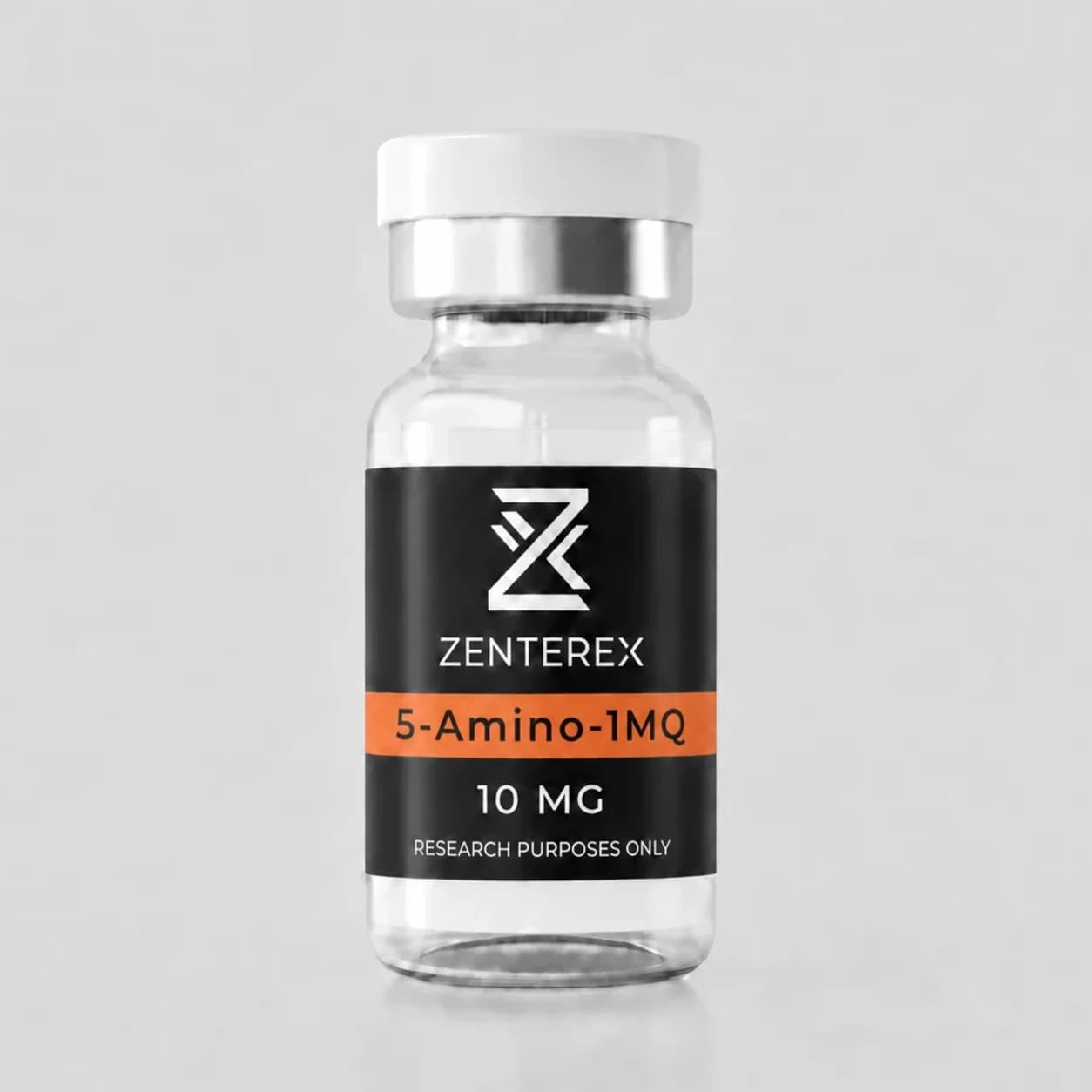
5-Amino-1MQ comes as a freeze-dried powder, for lab research only.
What the molecule is
The full name is 5-amino-1-methylquinolinium. A quinolinium is a double ring built around nitrogen, carrying a positive charge. The rest of the name says what is stuck where: an amino group at position 5, a methyl group on the ring nitrogen.
- Molecular weight: 159.21 g/mol (free cation)
- CAS number: not listed
- Comes as a freeze-dried powder, in a 10mg vial
- Store it at minus 20 degrees Celsius, away from light
At 159.21 g/mol this is by far the smallest thing we sell. About a third the weight of the three-bead GHK-Cu, and about a thirtieth of TB-500.
So a 10mg vial holds a very large number of molecules. Comparing it by weight against a peptide is meaningless. Our calculator converts.
Two notes on the paperwork.
The weight is quoted for the free cation. The molecule carries a permanent positive charge, so it is supplied as a salt with a partner ion alongside it. The salt weighs more.
And **no CAS number is listed**. That is a fact about the registry, not about the compound. The formula and the weight do the identifying instead, as our note on why CAS numbers matter covers.
What NNMT is
The published mechanism is blocking an enzyme called nicotinamide N-methyltransferase, or NNMT.
NNMT sticks a small chemical tag onto nicotinamide. That is all it does.
Why that matters comes down to where nicotinamide sits. It is a building block in the loop that rebuilds NAD+, the helper molecule at the centre of cell energy chemistry.
Tagging nicotinamide takes it out of that loop.
Think of a recycling bin with a hole in the bottom. Some of what should go round again drops out instead. NNMT is the hole. Block it and less is lost.
So the published reason for studying blockers of this enzyme is their connection to how much NAD+ a cell has. That is why a small-molecule enzyme blocker sits in our cellular peptides group alongside NAD+ itself. It reaches the same chemistry from the other end.
Blocking is not switching on
Worth spelling out, because it changes what the tests look like.
A **receptor key** fits a lock and turns it, starting a signal inside. Most of our range works this way, like Ipamorelin at GHSR-1a.
An enzyme blocker gums up a machine so it works more slowly. Nothing is switched on. Something is slowed down.
So the measurements differ. Key studies measure the signal that follows. Blocker studies measure the enzyme's speed directly: how fast the reaction runs against how much blocker is present. That gives you the amount needed to halve its speed, and tells you whether the blocker competes for the same slot as the normal ingredient or sits somewhere else.
5-Amino-1MQ looks quite like 1-methylnicotinamide, which is the enzyme's own product. That resemblance is the basis for its published interaction with the enzyme.
What researchers have looked at
Published studies in dishes and in animals cover three areas.
Blocking the enzyme
The main published mechanism, measured as enzyme speed in dish tests.
NAD+ chemistry in cells
Published work reports measurements to do with the NAD+ recycling loop in cell culture, following from where the enzyme sits.
Fat cell cultures
Some of the published work is done in cultured fat cells, where NNMT is present. These are cell culture measurements and describe those systems.
Reading the research
Two cautions.
The compound is recent and the research is thin. NNMT blockers are an active field but a young one. The body of work is small next to the peptides in our range, and its research-status label says so.
The naming varies. You will see 5-amino-1MQ, 5-amino-1-methylquinolinium, and various salt names. With no CAS number listed, matching a paper to material means reading the chemical name and the formula carefully.
Handling and paperwork
A 10mg vial of freeze-dried powder. Keep it at minus 20 degrees Celsius, out of the light. The product page says what it dissolves in.
As a small charged molecule rather than a peptide, it handles differently from most of the range. No sequence. No beads that can oxidise. And none of the clumping that affects bigger chains.
5-Amino-1MQ does not currently have a published batch report. It is simply absent, rather than covered by some other compound's document. We would rather show the gap than imply coverage we do not have.
Everything we sell is for lab research only. It is not a medicine, and it is not for people or animals to take.