
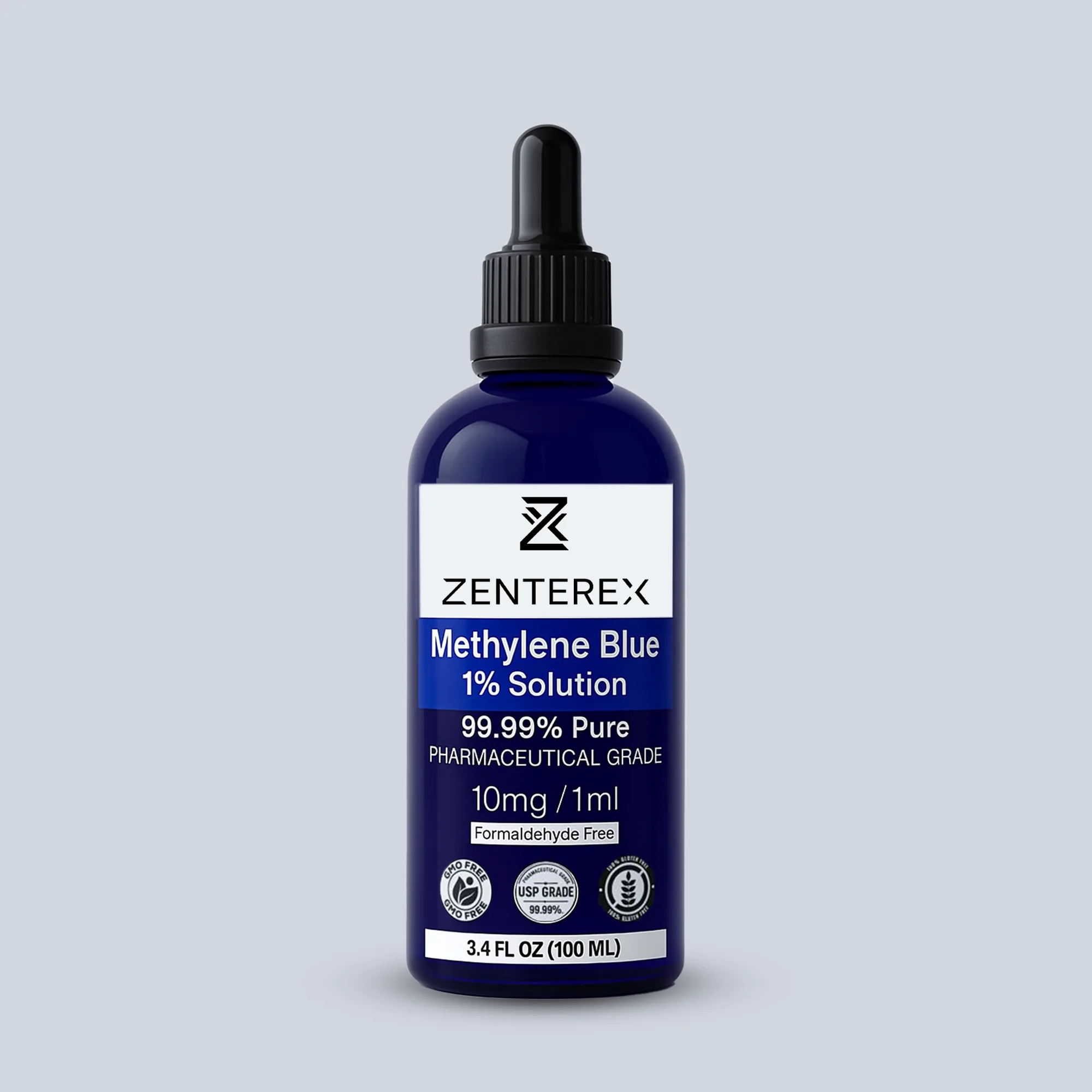
What Is Methylene Blue? A Plain-English Guide
Methylene blue explained simply: a 150-year-old dye, not a peptide, whose two published behaviours both come from the same property.
Methylene blue is by far the oldest thing we sell, and the least like the rest of it. It is a dye, not a peptide.
Both of its main published behaviours come from one property. It absorbs light, and it moves electrons about.
Methylene Blue is supplied for lab research only.
What the molecule is
A lab-made phenothiazine dye. Phenothiazine is a triple ring built from sulphur and nitrogen. The dye hangs two extra groups off it. The result soaks up visible light very strongly.
- Molecular weight: 319.85 g/mol
- CAS number: 61-73-4
- Comes as a powder or a solution, supplied as 100ml
- Store it at minus 20 degrees Celsius, away from light
That CAS number is remarkably short. Registry numbers are handed out in order, so 61-73-4 marks it as one of the earliest entries in the modern chemical record.
It was first made in 1876. It is among the oldest lab-made compounds still in everyday use, with a far longer history than anything else we supply.
Not a peptide
Worth saying, since it sits in a range of peptides.
Methylene blue has no amino acids and no peptide bonds. It is a small ring. So several fields on a peptide product page are simply blank. No sequence, no beads, no joining steps.
Identity rests on the formula and the weight. The same goes for NAD+ and 5-Amino-1MQ, the other non-peptides in our cellular peptides group. Our note on peptide sequences covers how identity works without one.
It is also the only thing we sell as a liquid rather than a dry powder, which changes the handling picture completely.
The electron chemistry
This is the compound's defining property, and the source of both its uses and its hazards.
Methylene blue flips back and forth between two forms.
The oxidised form is blue. The reduced form is colourless. Take on two electrons and a proton and blue becomes colourless. Lose them and it goes back.
Two things follow.
It carries electrons. In a test system it takes electrons from one place and hands them to another. That is why a dye turns up in mitochondrial research at all.
The colour tells you the state. The two forms look different, so you can follow the compound's state by eye. That is why it has served as a redox indicator for over a century. A colourless reagent never gives you that.
The light problem
The second published behaviour, and the one that most affects handling.
A dye is by definition something that soaks up visible light. Methylene blue takes that light and hands the energy to oxygen, making reactive oxygen.
That is a known, characterised property, not an accident. It is the basis for the compound's published use as a photosensitiser.
So light is a front-rank variable here, in a way it simply is not for a colourless peptide. Our note on light sensitivity covers the general case, and this is its clearest example.
For experiment design the consequence is sharper still. A test containing methylene blue, sitting in the light, is generating reactive oxygen whether you meant it to or not. Light control is part of the design. A difference in lighting between two arms of an experiment is a genuine confounder.
What researchers have looked at
Published studies in dishes and in animals cover three areas.
Moving electrons
The core published chemistry, and the most settled. Tests measure how it takes and gives electrons in defined systems.
MAO blocking
Published work describes it blocking an enzyme called monoamine oxidase, measured as enzyme speed in dish tests. That is blocking, not switching on. Same kind of mechanism as 5-Amino-1MQ at NNMT.
Mitochondrial electron transport
Following from the electron chemistry, published dish work reports measurements here.
Grade matters more here than usual
A point specific to this compound, because of its long history.
Methylene blue has been made at wildly different grades, for wildly different purposes. Textile dyeing among them.
Lower grades can carry traces of metal. That matters not at all when dyeing fabric. It matters a great deal in a cell test, because trace metals do their own electron chemistry.
For a compound whose entire published behaviour is electron chemistry, a metal contaminant is not a minor impurity. It is a competing actor.
So grade and provenance carry more weight here than for most compounds, and a purity figure on its own tells you less than usual.
Handling and paperwork
Supplied as 100ml. Store at minus 20 degrees Celsius, away from light.
Coming as a liquid changes everything about the handling. No dissolving step, no cake, and none of the freeze-drying issues that apply elsewhere.
Instead, the compound is already in the state peptides are least stable in. So light and temperature do more of the work here.
It also stains skin, clothes and surfaces. A practical caution rather than a chemical one, but a reliable one.
Methylene blue does not currently have a published batch report. We have not published one, rather than showing another compound's document in its place.
Everything we sell is for lab research only. It is not a medicine, and it is not for people or animals to take.