
What Is DSIP? A Plain-English Guide
DSIP explained simply: a nine-bead peptide first pulled from rabbit blood in the 1970s, and the unusually unsettled state of what is known about it.
DSIP is the least settled compound in our CNS group. That is the most useful thing to know about it.
Semax and Selank have defined parents and deliberate design changes. DSIP has an isolation story and a research body that has never quite come together.
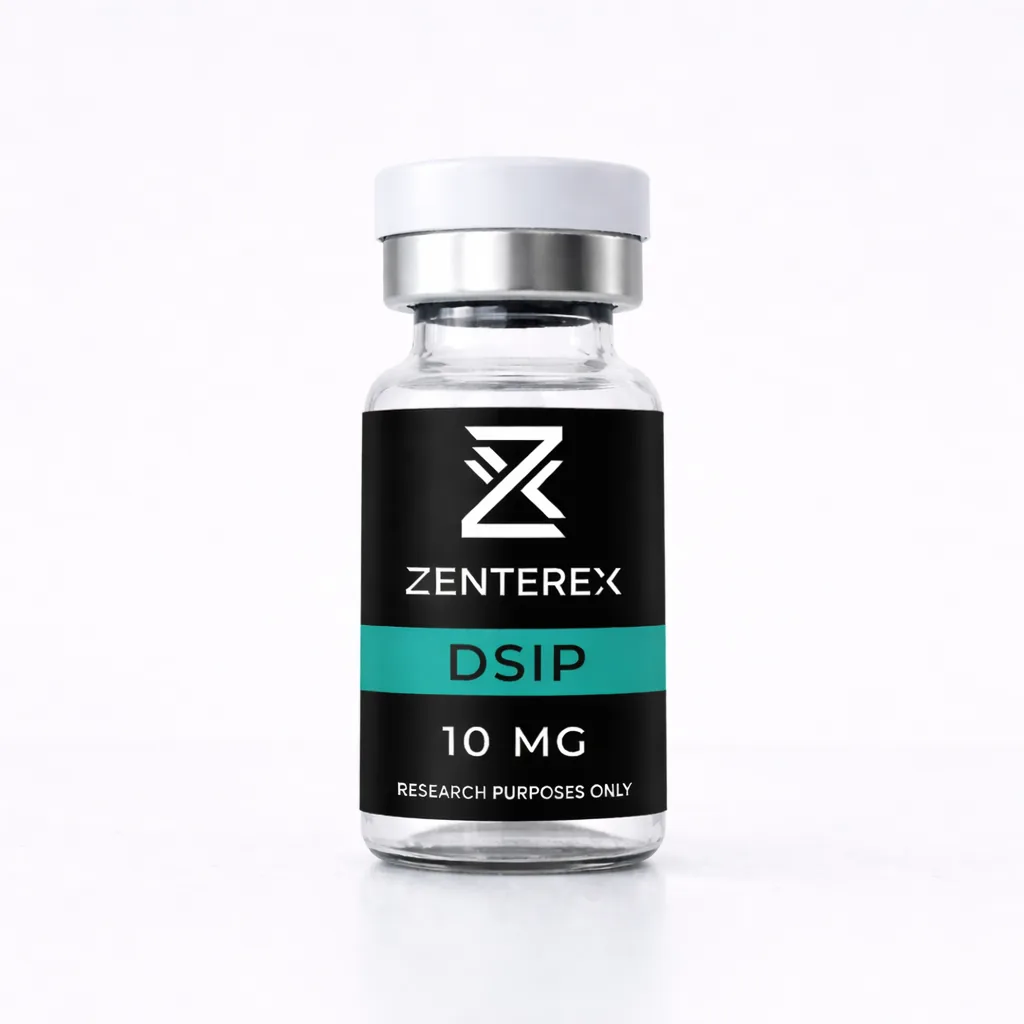
DSIP comes as a freeze-dried powder, for lab research only.
What the molecule is
DSIP has nine beads. It was first pulled out of blood taken from rabbit brains in the 1970s.
- Molecular weight: 848.82 g/mol
- CAS number: 62568-57-4
- Comes as a freeze-dried powder, in a 10mg vial
- Store it at minus 20 degrees Celsius, away from light
The name is a label, not a description
The abbreviation comes from the phrase used when the compound was first described. It was named after the experiment it came out of.
That was normal for the period. Several compounds carry names of the same kind. TB-500 is named for the tissue its parent came from. Thymulin likewise. GHK-Cu's name is its sequence plus its metal.
The point is that the name identifies, it does not describe.
A name given in 1974, based on the one test in front of the researchers that day, records what that test was. It does not record a settled understanding of the molecule.
Reading a compound's name as a summary of what it does is a mistake generally. Here it is a particularly expensive one.
The sequence, the weight and the CAS number are the identifying facts. Our note on why CAS numbers matter makes the general case.
The state of the research
This is the substance of the entry, and it is unusual enough to say plainly.
DSIP's research is labelled preliminary on its product page, and that label is doing real work. Four things set it apart from everything else we sell.
**No settled receptor.** Ipamorelin has GHSR-1a. CJC-1295 has the GHRH receptor. DSIP has no widely agreed target. Published work reports binding, but no consensus mechanism has emerged.
Findings have been hard to repeat. The original results have a published history of inconsistent replication. That inconsistency is part of the record, not a gap in it.
The research is long and thin. It spans five decades without converging. That is a different situation from a compound with a small but coherent body of recent work.
Even its natural occurrence is debated. Whether the peptide occurs naturally, where, and in what amounts, has been an open question for much of its history.
What researchers have looked at
Three areas, and all of it should be read with the caveats above.
Binding behaviour
Reported binding studies in tissue preparations. These describe binding, which is not the same as switching anything on, and they have not settled on a target.
Brain chemistry in animals
Published animal work reports measurements to do with signalling chemicals. Described as preliminary.
Detecting it at all
A methods thread about how to find and measure the peptide in biological samples. That bears directly on the question of whether it occurs naturally.
Why we label it preliminary
A supplier can present a compound like this two ways.
One is to copy the confident framing of second-hand sources, which for DSIP are far more assured than the original research warrants.
The other is to say plainly that the evidence is thin and unsettled.
We do the second, and the research-status label says so. Our three labels — extensive, moderate, preliminary — describe how much has been published and how settled it is. They are not a quality ranking of the material, which is tested for identity and purity like everything else.
A compound with unsettled research is a perfectly legitimate research subject. It only becomes a problem when it is described as though the questions were closed.
Handling and paperwork
A 10mg vial of freeze-dried powder. Keep it at minus 20 degrees Celsius, out of the light. The product page says what it dissolves in.
Batch analysis is published. Each report confirms identity by weighing the molecule against the expected 848.82 g/mol, and reports purity by chromatography.
Whatever the state of the pharmacology, the analytical work on this material is exactly as rigorous as for the rest of the range. That is worth separating clearly. Not knowing what a molecule does is not the same as not knowing what is in the vial.
DSIP sits in our CNS research peptides group.
Everything we sell is for lab research only. It is not a medicine, and it is not for people or animals to take.